Depth First Search Algorithm to Compute the Diameter of N-Ary Tr
- 时间:2020-10-11 15:17:18
- 分类:网络文摘
- 阅读:146 次
Given a root of an N-ary tree, you need to compute the length of the diameter of the tree. The diameter of an N-ary tree is the length of the longest path between any two nodes in the tree. This path may or may not pass through the root.
(Nary-Tree input serialization is represented in their level order traversal, each group of children is separated by the null value.)diameter-n-tree
Example 1:
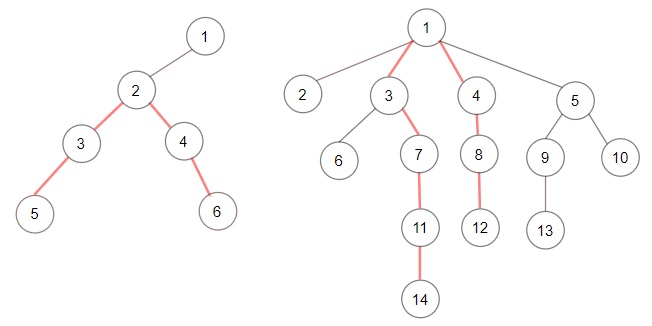
Input: root = [1,null,3,2,4,null,5,6]
Output: 3
Explanation: Diameter is shown in red color.Example 2:
Input: root = [1,null,2,null,3,4,null,5,null,6]
Output: 4Example 3:
Input: root = [1,null,2,3,4,5,null,null,6,7,null,8,null,9,10,null,null,11,null,12,null,13,null,null,14]
Output: 7Constraints:
The depth of the n-ary tree is less than or equal to 1000.
The total number of nodes is between [0, 10^4].Hints:
For the node i, calculate the height of each of its children and keep the first and second maximum heights (max1_i , max2_i).
Check all nodes and return max( 2 + max1_i + max2_i ).
C++ Definition of N-ary Tree
1 2 3 4 5 6 7 8 9 10 11 12 13 14 15 16 17 | // Definition for a Node. class Node { public: int val; vector<Node*> children; Node() {} Node(int _val) { val = _val; } Node(int _val, vector<Node*> _children) { val = _val; children = _children; } }; |
// Definition for a Node.
class Node {
public:
    int val;
    vector<Node*> children;

    Node() {}

    Node(int _val) {
        val = _val;
    }

    Node(int _val, vector<Node*> _children) {
        val = _val;
        children = _children;
    }
};Compute the Diameter of a N-ary Tree
Similar to compute the depth of a Binary Tree, we can extend the same algorithm to compute the depth of a N-ary tree. To solve this problem, we also need to remember the top 2 depths for each children. Thus, we can integrate this in the Recursive Depth Function.
1 2 3 4 5 6 7 8 9 10 11 12 13 14 15 16 17 18 19 20 21 22 23 24 25 26 27 28 | class Solution { public: int diameter(Node* root) { depth(root); return ans; } private: int ans = 0; int depth(Node* root) { if (!root) return -1; int curDepth = 0; int m1 = 0, m2 = 0; for (const auto &n: root->children) { int d = depth(n); curDepth = max(curDepth, d); if (d > m1) { m2 = m1; m1 = d; } else if (d > m2) { m2 = d; } } ans = max(ans, m1 + m2); return curDepth + 1; } }; |
class Solution {
public:
    int diameter(Node* root) {
        depth(root);
        return ans;
    }

private:
    int ans = 0;

    int depth(Node* root) {
        if (!root) return -1;
        int curDepth = 0;
        int m1 = 0, m2 = 0;
        for (const auto &n: root->children) {
            int d = depth(n);
            curDepth = max(curDepth, d);
            if (d > m1) {
                m2 = m1;
                m1 = d;
            } else if (d > m2) {
                m2 = d;
            }
        }
        ans = max(ans, m1 + m2);
        return curDepth + 1;
    }
};The diameter of the N-ary tree is equal to the maxmium value of the sum of the Top 2 depths for each node. The N-ary tree will be visited exactly once and thus the Time complexity is O(N). Due to recursive implementation, the Space requirement is O(N) – the usage of implicit stack. And the N-ary tree may be degraded into a linked list – which means the depth may be exactly N for N nodes.
–EOF (The Ultimate Computing & Technology Blog) —
推荐阅读:Activist’s Mother Faces Prison After One-Word Facebook Reply Ed-Tech Start-Ups Can Allow Anyone To Become A Teacher Russian Hacker Sold Millions Of Passwords For Less Than A $1, Sh How To Successfully Fine-tune Your Overall Social Media Strategy What It Really Takes To Make Money As a Blogger How Do You Increase Website Domain Authority? Bitcoin Expert Regrets Blogging About Rumored Bitcoin Creator WordPress Theme Seller, Templatic, Warns Users Of Hacking Samsung Utilizes Virtual Reality Stories For Children’s Bedtimes 6 Things You Need to Do Before Writing a Single Word on Your Blo
- 评论列表
-
- 添加评论